Defined before built
Acceptance criteria are agreed before implementation, so quality is measured against a shared expectation rather than an impression.
DEW-IT is an IT company that designs, builds and maintains software systems. We are deliberately structured so that the people who understand a system are the people who remain available to it.
We take on custom software development, web application engineering, cloud infrastructure, system integration, modernisation, quality assurance and technical support. Engagements range from a single well-defined service to long-running responsibility for a platform.
Our work is documentation-heavy by intention. Architectural decisions, interfaces and operational procedures are written down as they are made, so that the organisations we work with own their systems rather than depending on recollection. All communication, documentation and delivery are handled in English.
02 / Mission
To build software that organisations can rely on and understand — systems that behave predictably, can be changed safely, and remain maintainable long after the first release. We measure our work by how well it serves the people who use and operate it every day.
03 / Vision
A software landscape where reliability is ordinary: where releases are routine, security is designed in from the beginning, and technical decisions are recorded clearly enough that any competent engineer can pick up the work and continue it.
04 / Principles
A problem that cannot be described plainly is not ready to be implemented. We resolve ambiguity first.
Change arrives in increments that can be reviewed, deployed and, if necessary, withdrawn.
Estimates, risks and limitations are communicated as they are, including when the answer is inconvenient.
Responsibility does not end at handover of a feature; it ends when the system runs as intended.
Proven tools with good documentation beat novelty in systems that must run for years.
Anyone joining the project later should be able to reconstruct why it is built the way it is.
05 / Technology
We choose technology for the shape of the problem and the capabilities of the team that will keep the system running. A stack that no one in the organisation can operate is a liability regardless of its merits.
Where an existing platform is sound, we extend it. Where it genuinely blocks progress, we plan a migration in stages that keeps the business running throughout rather than proposing a rewrite as a first response.
Portability matters: infrastructure described as code, data in open formats, and interfaces defined independently of any single vendor.
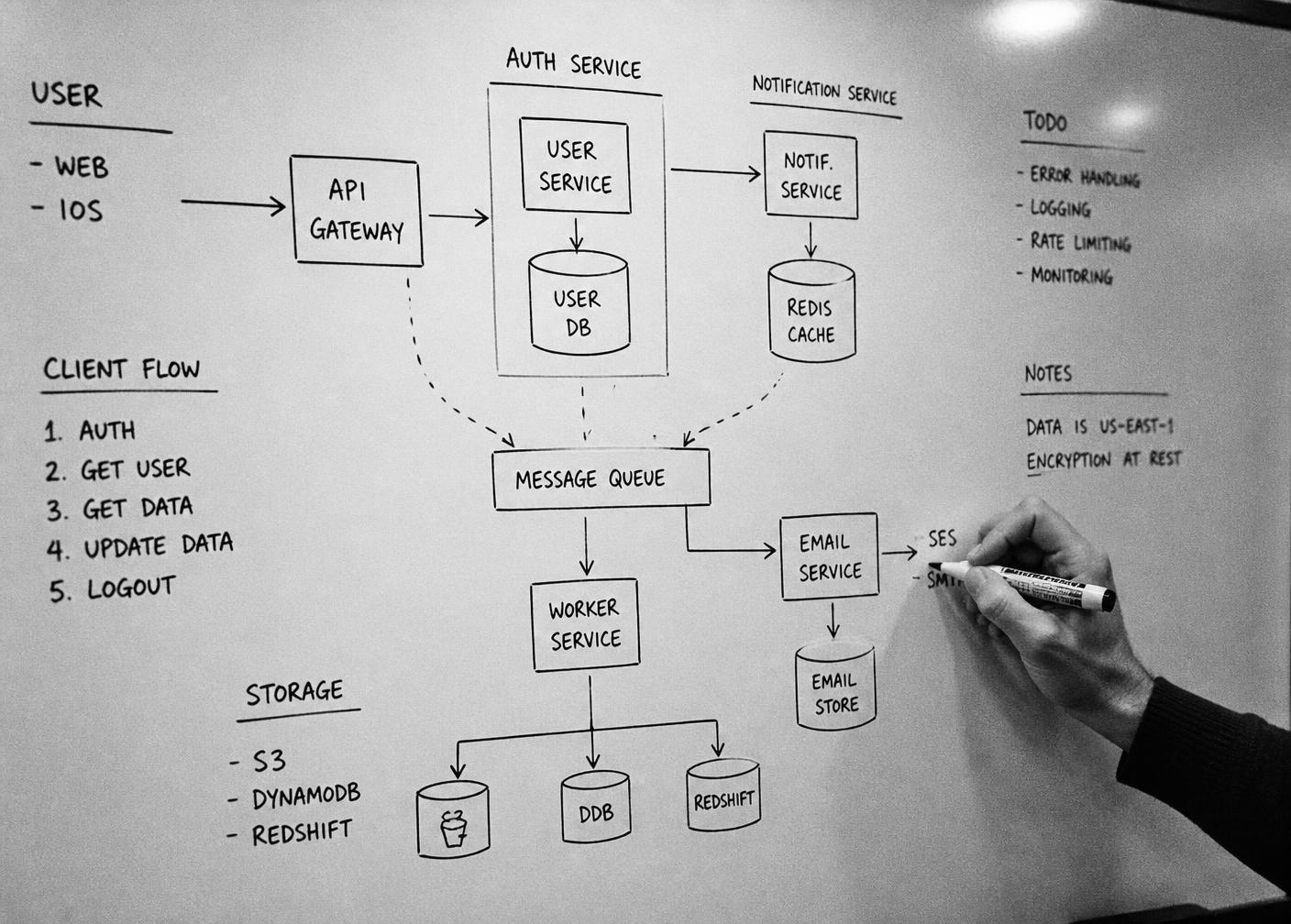
Acceptance criteria are agreed before implementation, so quality is measured against a shared expectation rather than an impression.
Automated tests concentrate on business rules, boundaries and failure modes instead of chasing a coverage figure.
Every change is read by someone other than its author before it reaches a production environment.
07 / Security
We treat authentication, authorisation, secret management and data handling as first-class design concerns. Inputs are validated at boundaries, permissions are explicit, and sensitive values never live in source control.
Dependencies are kept current and reviewed for known issues. Where a system processes personal data, we minimise what is collected, document where it is stored, and build deletion paths at the same time as the features that create the data.

08 / Collaboration
Work is visible in one place, prioritised together, and revised as understanding improves.
Progress is shown in a running environment on a predictable rhythm.
Anything that affects architecture or data is recorded with its reasoning.
Questions go straight to the engineer who can answer them.
Documentation, runbooks and access are transferred as part of delivery, not afterwards.
09 / Contact
Questions about how we work, or about a system you are responsible for, are welcome by email.